VitaFlow is built as a structured healthcare data governance layer — not a centralized database, and not a temporary integration bridge.
Our architecture enables secure interoperability across public and private healthcare systems while preserving data sovereignty at the source.
Architectural Philosophy
Infrastructure Above Systems
VitaFlow does not replace existing healthcare systems.
It introduces a governance layer above them.
The core principles:
Data remains at source
Access occurs through controlled API gateways
Policies govern usage, not individual systems
Auditability is mandatory
Scalability is structural
This ensures long-term flexibility without exponential integration complexity.
Federated Model Explained

Three-Layer Federation Model
1. Public Sector Federation
National registries, regulatory bodies, oversight systems.
2. Healthcare Provider Federation
Hospitals, clinics, laboratories — public and private.
3. Data Operator Federation
EHR vendors, integrators, laboratory systems, digital health platforms.
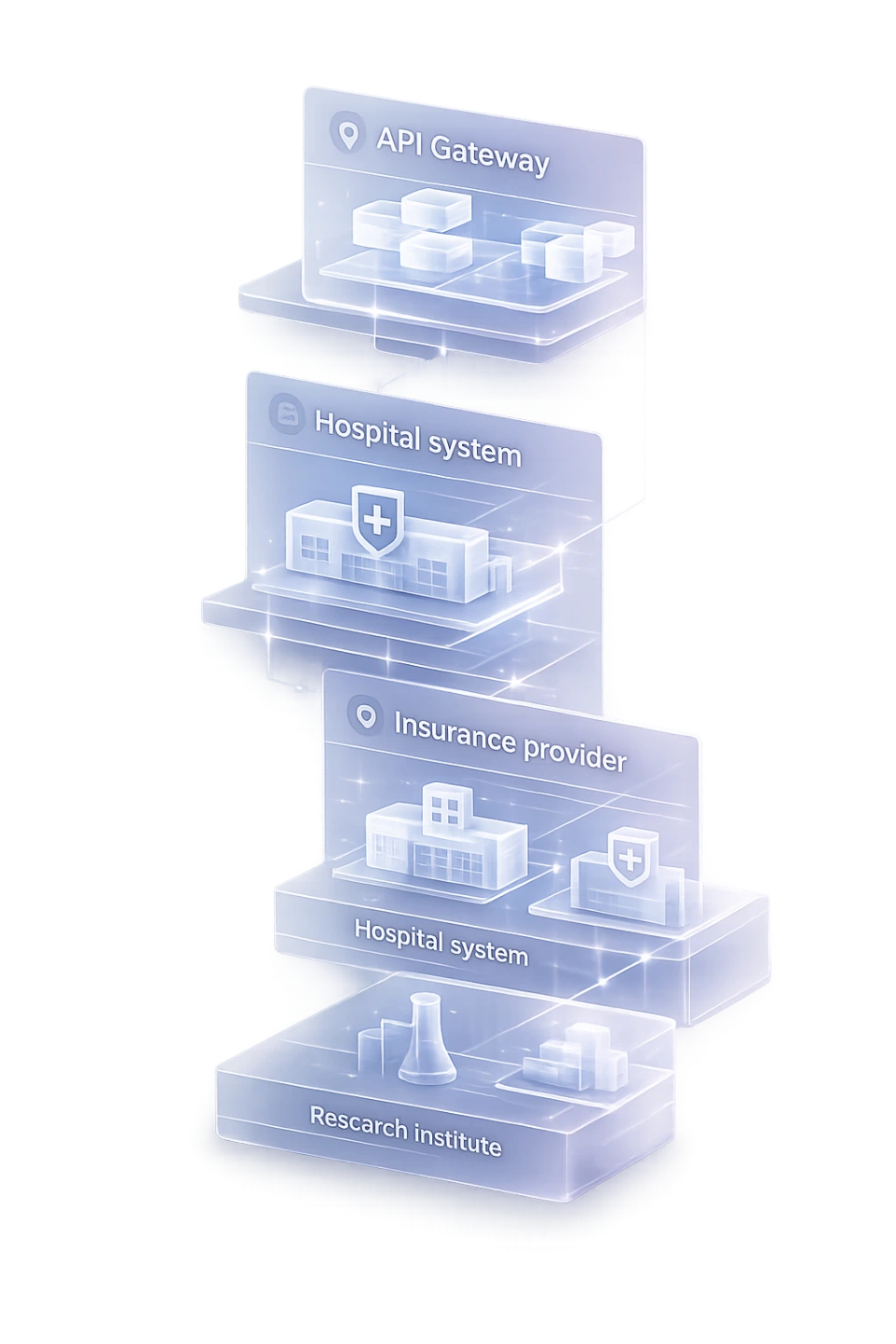
Each federation operates independently yet connects through a unified governance gateway.
No single point of data centralization.
No uncontrolled file exchange.
No duplication of ownership.
API-First Governance Layer
API-Only Access Model
All interactions occur through structured APIs.
Key characteristics:
API-first architecture
FHIR R4/R5 compliance
DICOM support
OMOP compatibility
Controlled purpose-based access
Immutable audit trail
The gateway enforces policy before access is granted. Governance is embedded in the topology — not applied afterward.
Security Architecture
Security by Design
VitaFlow incorporates:
TLS encryption
Hardware Security Module (HSM) key management
Mandatory penetration testing before production
SAST / DAST code analysis
Software Bill of Materials (SBOM) transparency
Immutable logging
Privacy Impact Assessments (PIA/DPIA) per new data source

Security policies scale alongside the federation.
Data Governance & Secondary Use
Primary Use (Operational)
Clinical workflows, direct patient care, institutional reporting.
Secondary Use (Analytical & Research)
Pseudonymization regimes
Anonymization layers
DUO-coded access logic
Reproducible data pipelines
Secure AI sandbox environments
This allows innovation without compromising compliance.
Onboarding & Scalability Model
Structured Expansion Without Structural Risk
Each new data source follows a repeatable onboarding process:
1. Architectural assessment
2. Policy and compliance validation
3. API integration
4. Monitored production activation
The model scales:
1
Horizontally
3 → 20+ sources per federation
2
Vertically
Federation-to-national level
3
Internationally
EHDS cross-border readiness
Integration cost does not grow exponentially with each connection.
Decentralized Infrastructure Topology

Distributed Resilience
VitaFlow supports decentralized infrastructure models including:
- Localized federation nodes
- Edge computing components
- Redundant network pathways
- Resilient availability design
This increases system robustness and reduces systemic vulnerability.
EHDS & European Alignment

Built for European Health Data Space
The architecture supports:
- GDPR alignment
- EHDS secondary data framework readiness
- Cross-border federation compatibility
- Transparent consent governance
- Policy-based access enforcement
VitaFlow is designed to become a national foundation that extends into European-level data ecosystems.

Architecture Determines Capability.
It is achieved through structural governance design.